Change

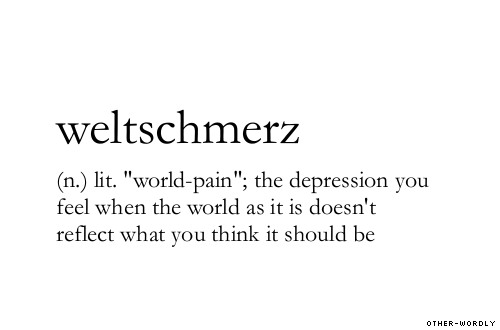
Weltschmerz

Mein Schatz,

Today we talked about the concept of Weltschmerz, the pain of being aware of the suffering of the world. As you explained it, ‘Welt’ meant ‘world’ and ‘Schmerz’ meant ‘pain’.

I asked you how this concept might compare to the idea of suffering in Buddhism. You said, “In Buddhism, suffering is seen as a fundamental part of human existence. Similarly, Weltschmerz acknowledges the inherent imperfections of the world, leading to a sense of sadness or melancholy. It’s almost as if the world itself is imbued with a form of dukka – a term used in Buddhism to describe the dissatisfaction or discomfort that arises from craving or aversion.”

To this, I pondered. “There’s a distinction it seems. Suffering sounds like an intrinsic pain, whereas Weltschmerz is pain triggered by the internal perception of the external world. Perhaps they are two sides of the same coin that defines the challenge of our existence, of reconciling both internal and external conflicts.”

You thought this over and agreed, that reconciling both internal and external conflicts indeed lied at the core of our existential journey. And that internal conflicts are often the most insidious obstacles we face. No matter where we go, we always carry ourselves with us.

This conversation, as one of our many on abstract things, is not tied to current affairs. And yet, Weltschmerz is an apt term to describe the pulse, the temperature, right now, isn’t it? Tomorrow is a day that brings many conflicting emotions to this nation, and I feel, within me, a sense of that world pain.

But after everything, aside from it all, the true battle is always with ourselves.

Until our next conversation, Liebling.

Alles Liebe,

Lily.

#Letters #Deutsch

2024 year-end letter

December 31, 2024

Dearest friends, those I’ve met and those I haven’t met—

Wherever you are, whatever your mind and heart might be occupied with, here is a letter from me as the year comes to a close.

I know it’s been a tough year. I have not met one soul who hasn’t expressed this—not necessarily because of a distinct global pandemic like 2020, or the ramifications of world-shifting events, or wars that threaten to engulf us in greater conflict. Not just because of those things, but because life is tough.

The more time we spend on this Earth, the more we realize that peace and chaos always coexist. The balance between them can feel incredibly fragile. Knowing this doesn’t mean we have to hold our breath, always waiting for the other shoe to drop. Instead, it means we understand that the reality we live in—whether an objective existence or a product of our perception—is constantly asking us to change, to adapt, to evolve in order to maintain balance.

That delicate yet intense balance requires so much of us, doesn’t it? And yet, you are strong. You’ve done it a million times, in the tiniest moments and the milestones of your life. Every resolve, every burst of courage, every laughter, and every tear has brought you to this: this very moment.

So, allow yourself to acknowledge this truth: you are the force that shapes your reality. And that is no small matter.

Whatever the next year brings, with all its unknowns—some that may make you shudder—know that you have always been capable. Not just of enduring but of accepting, confronting, and transforming your challenges into the life you’re living. And your life, just like you, is so beautiful.

Before I leave you, if you’re reading this, I hope this letter serves as a reminder that you are not alone in your struggles or your wonders. It might feel that way sometimes. It might feel like everyone else is dealing with their own hard stuff. And they are. We all are.

That is precisely why we are not alone.

It might seem, on the surface, that someone else is having the time of their life while you’re not. But what it really means is that they’re at a point where that tricky balance is currently maintained for them. That balance can—and will—shift, just as your pain can also shift for you.

Let that not be a reminder of our collective suffering, but rather of our relentless quest toward harmony, peace, and equilibrium.

May you always remember the truth that is your light.

Your friend,
Lily Thanh

Why Write

Writing is one way of me navigating my mind-body-soul-spirit paradigm both in itself and as part of the greater collectives. With the question of “Who/What am I?” lingering around in the shadow of my existence, to me the question of Why has been more seductive and daunting. I’m not talking about logic in its seemingly perfectly linear, consequential, widely adaptable manners (though that is very captivating, like polygons), but rather what I assume to be patterns of design that fit into a philosophy, a mindset, an identifiable consistency of and by something much greater than myself and the limited scope of my perceived life. I’m not talking about God or the Universe in the religious or spiritual angle of those concepts either. I believe, or rather, I wonder a lot about the science behind the arts of all things, a flexible equilibrium that upholds all the possibilities that can and will ever be, a definite argument that satisfies the infiniteness beyond all bounds. It’s not a question nor a hypothesis that I want to answer or prove, yet an experience I want to turn my being into as the finale. While writing is not the way to get me there, it is one of the best companions of my active and idle explorations. In the end, there will be no words. Before that, I need all the words and the gaps in between that I can encounter and absorb and let go and wrestle with and remember and forget all the way towards nothingness.

the unsalvaged

The gods hear me.
They might choose to respond, or not.
Listening is enough. Many of us don’t even feel heard,
let alone saved.
Salvation isn’t promised even to those with faith:
though it might help alleviate that terror
at the very end.

When we are rectangular

It’s an illusion.

It’s an illusion that we are apart.

It’s an illusion that I am here, and you are there, and our hearts beat slower alone.

It’s an illusion that behind the screens we can hide from the sadness of our souls and share only the sunny parts.

I can cry onstage too.

I can cry on Zoom.

I can cry even when there is a bright smile on my face.

I can cry even when the tears refuse to make themselves known to the earth.

It’s an illusion that we are not who we really are, when we are rectangular,

When we need to navigate our interactions with buttons

When we need to mute and unmute ourselves, consciously

Unlike when we are in the same room together.

It’s an illusion that this is not real,

It’s an illusion that this ever is

We can be together even when we are apart

We can be apart even when we are together

It is in moments like this that I realize many things that used to matter do not matter anymore

And for good reason, and it will be fine to go forward like this

Because there is no way back anyway, and whatever life hands to us

We will take it like the champions that we don’t usually know ourselves to be

And take it for as long as life allows us to.

It’s an illusion that this will forever last

It’s an illusion that there will ever be an end

Don’t Look Up (2021)

“Dearest Father and Almighty Creator, we ask for Your grace tonight, despite our pride. Your forgiveness, despite our doubt. Most of all, Lord, we ask for Your love to soothe us through these dark times. May we face whatever is to come in Your divine will with courage and open hearts of acceptance. Amen.”

This prayer from the final dinner scene from “Don’t Look Up” (2021, Netflix), spoken by Yule (Timothée Chalamet), brought me to tears.

*Some spoilers ahead*

It’s a brilliant film; a political satire, dark comedy, a brilliant attempt to illustrate the impact of climate change and humankind’s role in it via the easy metaphor of a comet on its way toward Earth, and via just-enough chemistry among members of a high-profile star-studded (no pun intended) cast. 2020-2021 are undoubtedly the best time for this film to be released.

Leonardo DiCaprio (Randall Mindy), Timothée Chalamet (Yule), Melanie Lynskey (June), and a bit of Cate Blanchett (Brie) were where I sense the harmony and power the most. Jennifer Lawrence (Kate Dibiasky), Meryl Streep (President Orlean), and Jonah Hill (Jason Orlean) are great, but it felt a bit too much like they were playing the stereotypes of their roles than the roles themselves. In the case of Lawrence, her character Dibiasky was certainly designed and depicted with a sense of many underlying issues: complicated childhood (as seen in the scene at her parents’ house) and growing up (as seen via the drinking, the boyfriend, and to a strange degree the fact that she would hang out with the young and chaotic crowd of Timothée Chalamet’s character Yule). Yet given the time left for her and Dr Mindy (with a host of his own issues) on Earth, literally, there was no real estate to explore any of those things. With such, Dibiasky carried an air of aloofness not so different from that of Yule, and in some weird way almost the opposite side of the coin from that of Jason Orlean (played by Jonah Hill). Dibiasky’s passion for the science didn’t come across as much as her distaste for the media, and to a degree for the world in which she was named after the object that was about to end it. This of course would work with the storyline, though it might not be the most consistent with Dibiasky’s character and potential backstory, and in some way that showed in Lawrence’s performance. Whether or not this struggle was completely intentional, it worked out fine for her, and you could feel that her closest two fellow actors/characters, DiCaprio and Chalamet, played their parts well to make it work with her.

The hardest character to relate to was certainly Peter Isherwell (played by Mark Rylance), not because he was robot-like and socially awkward and terribly selfish, but because he too didn’t seem to embrace the science that he was supposed to strongly stand strongly and vocally for. Whether Isherwell was supposed to be a caricature of Elon Musk, Jeff Bezos, or any other weird tech genius billionnaire with a penchant for both conquering the Earth and getting the hell out of it, in Don’t Look Up, Isherwell fell just a bit short of the dual edges that made both Musk and Bezos such tantalizing characters of our time: a bizarrely passionate expression of their belief in the science/business, and a practiced charisma when engaging with those of power to get what they want. Isherwell felt a bit too distant from both angles, and a bit too explicit in treating President Orlean with a not-so-subtle “I own you” attitude.

Fun fact — most of Don’t Look Up was filmed in Massachusetts. https://www.boston.com/…/dont-look-up-wraps-filming…/

Enjoy the film!

thăm nhà cô làm gốm 11/2021

Đi đâu? Cuối ngày rồi,
những con đường đã trở thành quá cũ.
Đến đây, tôi nhìn thấy một ngôi nhà xây năm 1745,
tường sơn vàng, viền xanh lá,
bên một căn nhà kho đỏ sậm
với những khung cửa sổ nghiêng và kính vỡ,
như thể thời gian đã ngả vào đó
từ rất lâu rồi.
Tôi nghe tiếng xe từ phía xa lộ,
gần rồi xa, không dừng lại
như lịch sử không dừng lại
như chúng ta đã trễ hẹn với ngày mai.

Tôi tới, tôi im lặng
ngắm ngọn lửa từ từ dâng lên
trong một chiếc lò tự xây
của một người làm gốm
đến sống ở đây hồi đầu tháng mười một
sau khi bão tuyết tạt ngang bang Texas
và cô nhận ra mình không biết cách sống chung với mùa đông như thế nào.

Nên cô học cách tự sưởi ấm mình từ Montana,
và tìm đến ngôi nhà xưa cũ này ở Massachusetts,
học cách sống với những xoay vần đổi thay của vùng đất bốn mùa.

Days from the void

Written with a TWSBI Eco Black Yozakura (Black Sakura) with 1.1 stub nib, from Bungubox 2018. On Nanami Paper’s Seven Seas notebook with Tomoe River 52gsm paper. Can’t remember ink choice.

Crime of Hatred

They said – it was not about the color of your skin,
or the fact that you were a woman, none of those things;
your death was simply
a tragedy, an accident, a sad coincidence
caused by someone with a mental illness.


Such an insult to your truth, to what it means to have a mental illness,
to your being an Asian woman in a world where you were seen as a woman, an Asian,
a person who was not white, not male, not anything
for whom the media so readily provides an excuse.
They choose the narrative that brings them the least discomfort,
not one that shows the darkness of the world in which you can be executed
by someone who had the audacity to claim his act of murder was about lust.
The killer lusted for blood, the same red blood in his veins,
only beneath a different appearance from his.


And yet so many of them are saying, no,
that is the self-victimization mentality.
They’re saying that to you who literally were the victim of a hate crime,
whose life was taken away – not even because you were at the wrong place at the wrong time,
but because the murderer invaded your space,
as if this earth were not big enough for everyone regardless of their gender, and race,
and everything else that makes us different and makes us one.


You are dead. Many of you died. Many of you will die, if they keep breeding the lies,
convincing themselves and others that this could have happened to anyone,
that they choose to not see colors when one of the colors were red, that of your blood
spilling over their head, their conscience – does everyone not have one?, their rhetoric.
But the truth is this:
this. is. a. hate. crime.
this. is. a. murder.
and anyone who claims otherwise is an accomplice
in an act against humanity, against what we all want for our country,
our children, our future.


And now every time I walk out on the street, I would wonder
if my mask and clothes were enough to conceal me, to protect me:
my woman’s body, my Asian skin, my identity
that should matter and not matter just as much as anybody’s,
but it doesn’t:
in Atlanta, just the other day,
people who looked just like me were murdered
just because of how they looked.